CJC-1295 and Ipamorelin: How the Stack Works
Summary
The CJC-1295 and Ipamorelin stack is the most widely used growth hormone peptide combination. It works because the two peptides trigger GH release through completely different receptor systems, producing a combined effect greater than either one alone.
How It Works
- CJC-1295 is a GHRH analog that binds GHRH receptors on pituitary somatotroph cells, signalling the pituitary to produce and release growth hormone. It has 4x greater receptor affinity than native GHRH (receptor binding study, 2010)
- Ipamorelin is a selective ghrelin receptor agonist (GHSR1a) that triggers GH release through an entirely separate pathway. A 1998 study (Raun et al.) showed it produces no cortisol or prolactin elevation even at 200x the effective dose
- Combined: CJC-1295 tells the pituitary to make GH. Ipamorelin tells it to release GH. Two signals, two pathways, one amplified pulse
Key Numbers
- Standard dose: 100-300mcg of each peptide, 1-3x daily via subcutaneous injection
- Cycle length: 8-16 weeks on, 4-8 weeks off
- Timeline: improved sleep by week 1-2, body composition changes by week 4-8
- DAC variant: extends CJC-1295’s half-life from 30 minutes to 6-8 days, but sacrifices pulsatile release pattern
View the CJC/IPA protocol data | Accumulation calculator
Two Pathways, One GH Pulse
Most peptide stacks combine compounds that work through similar mechanisms. The CJC-1295 and Ipamorelin combination doesn’t. These two peptides hit entirely different receptor systems on the same target cells.
CJC-1295 (also called Mod GRF 1-29 or Modified GRF) is a synthetic analog of growth hormone-releasing hormone. Your hypothalamus naturally produces GHRH to tell the pituitary gland to secrete growth hormone. CJC-1295 mimics that signal with roughly four times the binding affinity of the natural hormone (in vitro receptor binding study, 2010). It’s the accelerator.
Ipamorelin works through the ghrelin receptor, a completely separate signalling cascade. When ghrelin binds GHSR1a on pituitary somatotrophs, it triggers a calcium-dependent GH release that amplifies whatever GHRH is already doing. A 2002 cellular study (Cunha & Mayo) demonstrated that the presence of active GHS receptors potentiates GHRH signalling, meaning the two pathways don’t just add up. They multiply.
That’s the core argument for this stack. Not two peptides doing the same thing twice, but two peptides each removing a different bottleneck in GH secretion.
CJC-1295: The Signal Sender
CJC-1295 without DAC is a 30-amino-acid GHRH analog weighing 3,367.97 Daltons. Its half-life sits between 30 minutes and 2 hours, which matters more than it sounds.
That short half-life is actually the point. Natural GH secretion is pulsatile. Your pituitary fires GH in bursts throughout the day, with the largest pulse occurring during deep sleep. CJC-1295 without DAC preserves that pattern. A 2008 human study (24 subjects, 100mcg three times daily for 30 days) confirmed preserved natural GH pulsatility with no pituitary desensitization.
A 2006 pharmacokinetic study in 12 subjects showed peak GH at 15-30 minutes post-injection with doses of 100-200mcg. The GH pulse rises, does its work, and clears. Just like the body intends.
Molecular weight: 3,367.97 Da | Half-life: 30 min - 2 hours | 30 amino acids
Ipamorelin: The Clean Releaser
Ipamorelin is a pentapeptide weighing 711.85 Da. Five amino acids. Small molecule, big selectivity advantage.
The selectivity is what separates Ipamorelin from older growth hormone secretagogues like GHRP-2 and GHRP-6. All three bind the ghrelin receptor. But GHRP-2 and GHRP-6 also jack up cortisol, prolactin, and appetite. Ipamorelin doesn’t. Raun et al. (1998) showed zero significant cortisol or ACTH elevation even at 200 times the effective GH-releasing dose. That study is why Ipamorelin became the default GHRP for clinical protocols.
A 2019 GH stimulation study found consistent elevation 30-60 minutes post-injection at 200mcg daily over 8 weeks. A 2020 body composition trial (250mcg daily, 12 weeks) documented lean mass gains and bone density improvements in adults over 45. A 2021 sleep study showed improved sleep latency and increased slow-wave sleep at 200mcg before bed.
Molecular weight: 711.85 Da | Half-life: ~2 hours | 5 amino acids
DAC vs No-DAC: The Half-Life Trade-Off
This is the most common source of confusion. CJC-1295 comes in two variants, and they behave completely differently.
DAC stands for Drug Affinity Complex. It’s a molecular modification that binds CJC-1295 to albumin in the blood, dragging its half-life from 30 minutes up to 6-8 days. A 2006 study (Teichman et al.) in 12 subjects showed sustained GH and IGF-1 elevation lasting 6-10 days from a single injection, with peak levels at 2-4x baseline.
Sounds better, right? Longer duration, fewer injections. One shot a week instead of two or three daily.
The problem is physiology. Your body doesn’t maintain GH at a constant elevated level. It pulses. The CJC-1295 DAC variant provides continuous GHRH receptor stimulation, which is closer to exogenous HGH than to natural GH patterns. A 2012 animal study over 6 months found evidence of reduced GH pulse amplitude with prolonged DAC use, suggesting receptor desensitization. A 2015 pharmacokinetic comparison confirmed that the non-DAC variant preserves more physiological secretion patterns.
| CJC-1295 (No DAC) | CJC-1295 with DAC | |
|---|---|---|
| Half-life | 30 min - 2 hours | 6-8 days |
| Dosing | 100-300mcg, 2-3x daily | 1-2mg, once weekly |
| GH pattern | Pulsatile (natural) | Sustained elevation |
| Desensitization risk | Low | Higher with prolonged use |
| Ipamorelin pairing | Strong (matched pulsatile timing) | Reduced (continuous vs pulsatile conflict) |
| Side effects | Fewer, milder | More water retention, joint issues |
| Convenience | Low (daily injections) | High (weekly) |
| Best for | Long-term protocols, pairing with Ipamorelin | Short cycles prioritizing convenience |
Dosing Protocols
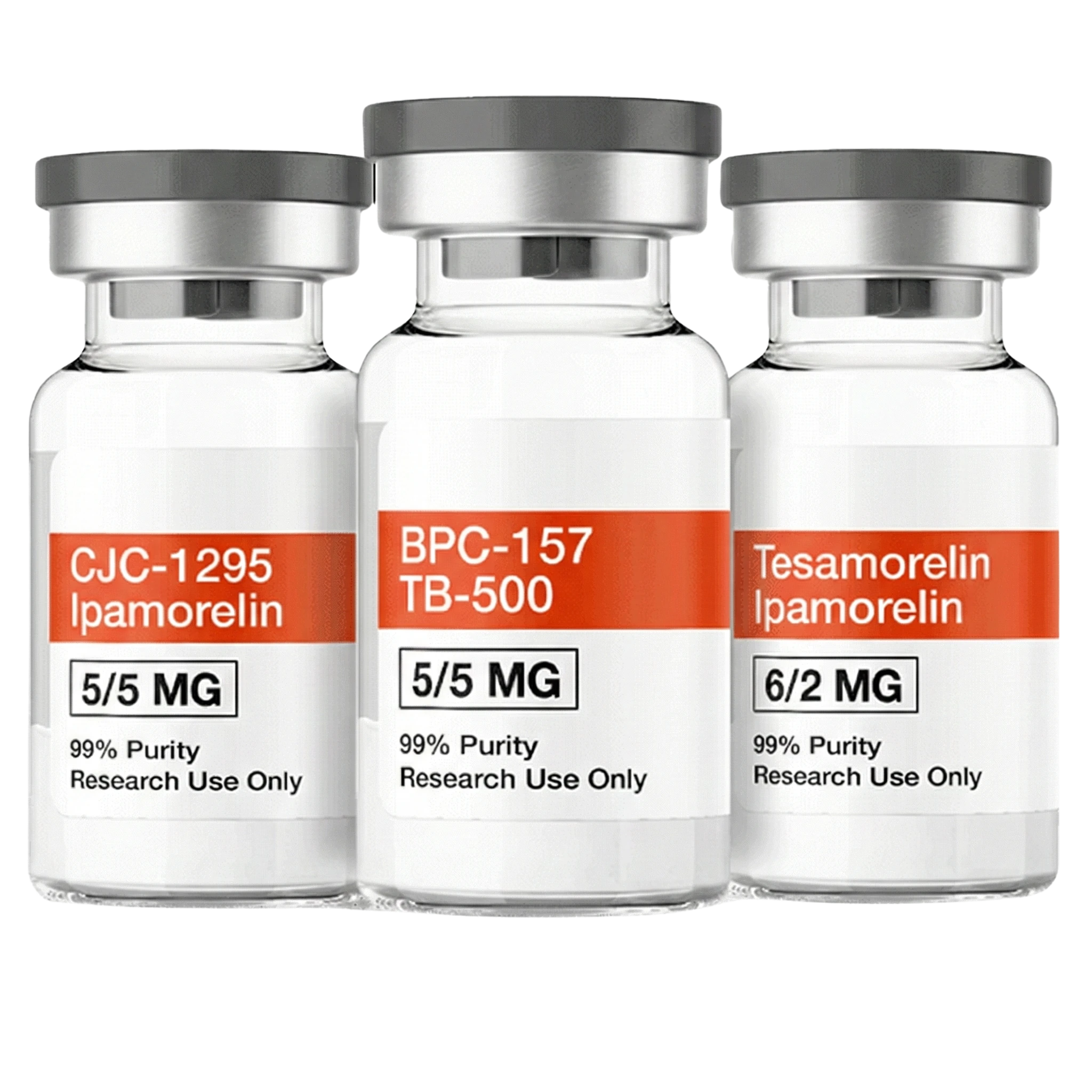
The CJC/IPA protocol is typically dosed at a 1:1 ratio. Standard blended vials contain 2mg CJC-1295 + 2mg Ipamorelin (4mg total).
Protocol Options
| Goal | CJC-1295 Dose | Ipamorelin Dose | Frequency | Notes |
|---|---|---|---|---|
| General health | 100mcg | 100mcg | 1x daily (bedtime) | Conservative starting point |
| Anti-aging/sleep | 150-200mcg | 200mcg | 1x daily (bedtime) | Most common protocol |
| Body composition | 200-300mcg | 250-300mcg | 2x daily (AM + PM) | More aggressive |
| Performance | 200mcg | 200-250mcg | 2-3x daily | Empty stomach required |
| Conservative | 150mcg | 150mcg | 5 days/week | Weekend breaks |
Timing Rules
Timing matters more for this stack than for most peptides. GH release is blunted by insulin and elevated blood glucose.
- Inject on an empty stomach, at least 2-3 hours after your last meal
- Wait 20-30 minutes after injection before eating
- Before bed is the single best timing, since it amplifies the natural nocturnal GH surge
- If dosing twice daily, morning (fasted) and bedtime are the standard windows
- Post-workout is an option for a third daily dose, but only if you haven’t eaten recently
Cycle Structure
- On cycle: 8-16 weeks
- Off cycle: 4-8 weeks
- Why cycle: Ipamorelin’s 2023 safety analysis noted potential receptor desensitization after 3-4 months of continuous use. Cycling resets sensitivity
- Monitor: IGF-1 bloodwork at baseline, mid-cycle, and post-cycle
Calculate your reconstitution volumes | Model accumulation over time
How It Compares to Alternatives
CJC-1295 + Ipamorelin isn’t the only GH peptide option. Here’s how it stacks up against the main alternatives.
vs Sermorelin
Sermorelin is the original GHRH analog. It was FDA-approved in 1997 for pediatric GH deficiency (discontinued in 2008 for manufacturing reasons, not safety). Its half-life is only 10-12 minutes with 6% subcutaneous bioavailability. CJC-1295’s 30-minute to 2-hour half-life and higher receptor affinity make it the more practical choice for most protocols.
That said, Sermorelin has the strongest human evidence base of any GHRH analog. A 1992 study by Corpas et al. in 60-78 year old males doubled 12-hour GH release over 6 weeks. It’s synergistic with Ipamorelin (3-5 fold GH increases documented). If you want the most clinically validated GHRH peptide, Sermorelin wins on evidence even though CJC-1295 wins on pharmacokinetics.
vs GHRP-2
GHRP-2 is more potent than Ipamorelin at raw GH stimulation. When combined with a GHRH peptide, GHRP-2 has produced up to 54-fold GH increases vs 20-fold with GHRH alone (Domestic Animal Endocrinology, 2000). But that potency comes with trade-offs: increased cortisol at higher doses, prolactin elevation, and a 35.9% increase in food intake (JCEM, 2010). Ipamorelin’s selectivity makes it the better choice for people who don’t want those side effects.
vs MK-677 (Ibutamoren)
MK-677 is an oral ghrelin mimetic. Convenient (no injections), but it provides continuous GH elevation similar to CJC-1295 DAC, raising desensitization concerns. It also significantly increases appetite and can cause insulin resistance with extended use. CJC-1295 + Ipamorelin offers more precise control over GH timing and magnitude.
Side Effects and Safety
The CJC-1295 and Ipamorelin stack has a reputation as one of the milder peptide protocols. That reputation is mostly deserved, with a few caveats.
Common Side Effects
- Facial flushing and warmth: 5-10 minutes post-injection. Resolves on its own. More common with CJC-1295 than Ipamorelin
- Mild water retention: Typical in the first 1-2 weeks, usually stabilises
- Vivid dreams and improved sleep: Technically a side effect, but most people consider this a benefit. Caused by GH’s effect on slow-wave sleep
- Mild hunger increase: 20-30 minutes post-injection from Ipamorelin’s ghrelin receptor activity. Much less pronounced than GHRP-6
- Injection site reactions: Minor redness or irritation. Standard for subcutaneous peptides
Serious Concerns
- The FDA has flagged immunogenicity risk for both peptides, including rare anaphylactic reactions
- Cardiovascular: Transient flushing, warmth, and hypotension post-injection (FDA warning)
- Carpal tunnel symptoms: Numbness, tingling in hands. This signals excessive GH/IGF-1 and means the dose should come down
- Blood glucose: GH antagonises insulin. People with diabetes or insulin resistance need to monitor glucose closely
- Joint pain: Persistent joint discomfort beyond the first 2 weeks is a sign to reduce dose or pause
Contraindications
- Active malignancy or cancer history
- Diabetic retinopathy
- Severe kidney disease
- Pregnancy or breastfeeding
- Existing carpal tunnel or nerve compression
- Pituitary tumours
Monitoring
- IGF-1 levels: Baseline, mid-cycle (week 6-8), and 4 weeks post-cycle
- Blood glucose: Essential for anyone with metabolic concerns
- Joint symptoms: Persistent pain or carpal tunnel signs warrant dose reduction
- Thyroid function: Sermorelin studies found 6.5% of users developed hypothyroidism; similar monitoring is reasonable for any GH protocol
The Practical Takeaway
The CJC-1295 + Ipamorelin stack works because it exploits a real biological principle: two independent signalling pathways converging on the same output. The human evidence for each individual peptide is solid. The stack logic is well-supported by receptor biology. And Ipamorelin’s selectivity gives this combination a cleaner side effect profile than older GHRP-based stacks.
Use the non-DAC variant of CJC-1295 for the best pairing. Dose before bed on an empty stomach. Run 8-16 weeks, then cycle off. Get IGF-1 bloodwork. Don’t skip that last part.
CJC-1295 peptide profile | Ipamorelin peptide profile | CJC/IPA protocol data | Reconstitution calculator | Accumulation plotter
Frequently Asked Questions
What does the CJC-1295 and Ipamorelin stack do?
CJC-1295 and Ipamorelin stimulate natural growth hormone release through two separate receptor pathways: GHRH receptors (CJC-1295) and ghrelin receptors (Ipamorelin). The combination produces amplified GH pulses that support body composition, recovery, sleep quality, and anti-aging effects. Neither peptide is FDA-approved for these uses.
What is the standard CJC-1295 Ipamorelin dosage?
The standard protocol is 100-300mcg of each peptide, injected subcutaneously 1-3 times daily on an empty stomach. The most common single-dose protocol is 200mcg of each at bedtime. Pre-mixed blended vials typically contain a 1:1 ratio. Use the reconstitution calculator for precise volumes.
Should I use CJC-1295 with or without DAC?
Without DAC for Ipamorelin pairing. The non-DAC variant’s 30 minute - 2 hour half-life matches Ipamorelin’s timing, creating synchronized GH pulses. The DAC variant (6-8 day half-life) provides continuous stimulation that conflicts with Ipamorelin’s pulsatile mechanism. DAC is better suited for standalone weekly protocols.
What are the side effects of CJC-1295 and Ipamorelin?
Common side effects include temporary facial flushing, mild water retention, vivid dreams, and slight hunger increase post-injection. Serious concerns include carpal tunnel symptoms (sign of excessive GH), blood glucose changes, and FDA-flagged immunogenicity risk. Both peptides are contraindicated with active cancer due to GH’s cell-proliferative effects.
How long does a CJC-1295 Ipamorelin cycle last?
Standard cycles run 8-16 weeks on, followed by 4-8 weeks off. Most users notice improved sleep within 1-2 weeks and body composition changes by week 4-8. The off-period prevents receptor desensitization, which Ipamorelin studies have flagged as a concern after 3-4 months of continuous use. Monitor IGF-1 bloodwork at baseline and mid-cycle.